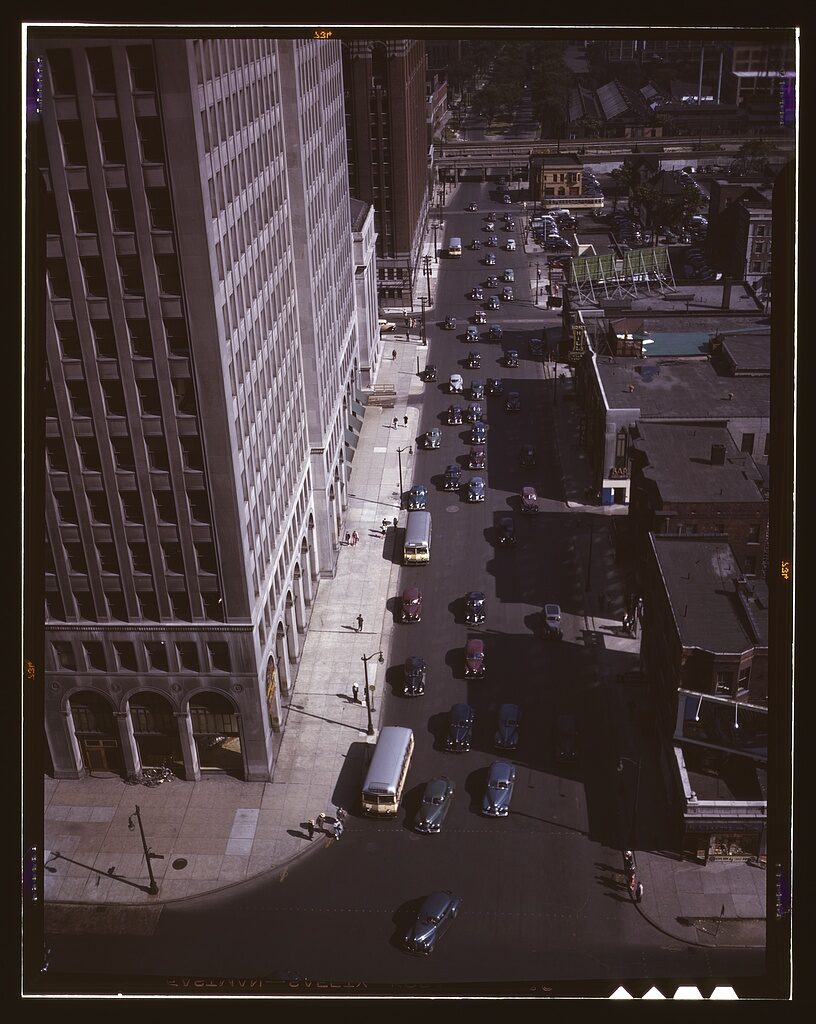
Source: Arthur S. Siegel / source record · Public domain — FSA/OWI
Crime history is more than a parade of sensational cases. To understand Detroit crime, you have to understand the city around it: where people lived and worked, how they traveled, what businesses stayed open late, where cash moved, how police communicated, how courts processed cases, and how newspapers described events to the public.
This section studies the structure surrounding crime while keeping the Ralph Palmer book investigations deliberately protected.
Targets, timing, commercial geography, getaway mobility, witness problems, and why robbery investigation depended so heavily on fast information.
OPEN FIELD FILE →Homes, stores, warehouses, factories, entry points, stolen-property markets, and the difference between a crime against a person and a crime against a place.
OPEN FIELD FILE →Scene preservation, witnesses, motive, medical evidence, weapons, timelines, and the slow assembly of a case before digital evidence existed.
OPEN FIELD FILE →Blind pigs, gambling, bookmaking, vice economies, enforcement pressure, informants, raids, and the overlap between legitimate nightlife and illegal markets.
OPEN FIELD FILE →Move beyond gangster mythology and examine networks: money, protection, illegal markets, intermediaries, fencing, corruption risk, and repeat relationships.
OPEN FIELD FILE →Cars changed opportunity, escape, jurisdiction, surveillance, and the geography of both offending and police response.
OPEN FIELD FILE →Street layout, land use, transit, taverns, factories, commercial strips, lighting, crowds, and why crime is rarely distributed evenly across a city.
OPEN FIELD FILE →Patrol, call boxes, radio, interviews, fingerprints, lineups, informants, surveillance, paper records, physical evidence, and the limits of the era.
OPEN FIELD FILE →How an incident could move from complaint to arrest, booking, prosecutorial review, court proceedings, testimony, and disposition.
OPEN FIELD FILE →Why a newspaper is evidence of what was reported—not automatically the complete case—and why separate papers may describe the same event differently.
OPEN FIELD FILE →Modern criminology gives us useful concepts—opportunity, guardianship, repeat locations, crime generators, mobility, land use, and environmental design. We can use those concepts to examine historical Detroit while clearly distinguishing a modern analytical lens from the language Detroit officers or reporters actually used at the time.
This section can explain crime types, methods, geography, courts, policing, and criminology in depth. When a concept intersects a Book One or Book Two case, the website may provide a brief archival connection or teaser—but not the investigative breakthrough, complete evidence chain, twist, or outcome.
CONTINUE IN THIS CATEGORY