No organized department
Detroit had no organized police department. In the early nineteenth century, a city marshal enforced laws, military commanders formed local militias, and various patrols and night watches helped police the growing city.
06 · THE DETROIT POLICE · INSIDE THE DEPARTMENT
The precincts. The call boxes. The bureaus. The badge.
ENTER THE DEPARTMENT ↓
BEFORE THE BADGE
The institution Ralph Palmer joined in 1946 had already developed across generations. Its beginning was not a single patrol car or station house, but a gradual move from local authority and night watches to an organized uniformed force.
Detroit had no organized police department. In the early nineteenth century, a city marshal enforced laws, military commanders formed local militias, and various patrols and night watches helped police the growing city.
A charter amendment created a police commission made up of the mayor and two council appointees. The Detroit Historical Society describes that first commission as ineffective.
Michigan’s legislature established a four-member Metropolitan Police Commission, creating the Detroit Police Department.
The first forty uniformed officers began duty. From that point, Detroit policing developed alongside a city expanding in population, territory, transportation and industry.
This section draws on the Detroit Historical Society’s Detroit Police Department history. It establishes institutional background only and makes no claim about Ralph Palmer’s individual service.
READ OUR EARLY POLICING NOTES → FOLLOW THE COMPLETE EARLY POLICING PATH →THE INSTITUTIONAL BACKBONE
This room is not a résumé. It is a working history of the Detroit Police Department as Ralph Palmer moved through it: patrol, Vice, detective work, robbery investigation, Special Investigation, Homicide, Narcotics and command. The surrounding sections connect the people, buildings, equipment and methods back to Detroit geography and the documented chronology.
THE PLACES
McGraw Station, neighborhood precincts, 1300 Beaubien and the buildings where police work began and ended.
PATROL DETROIT
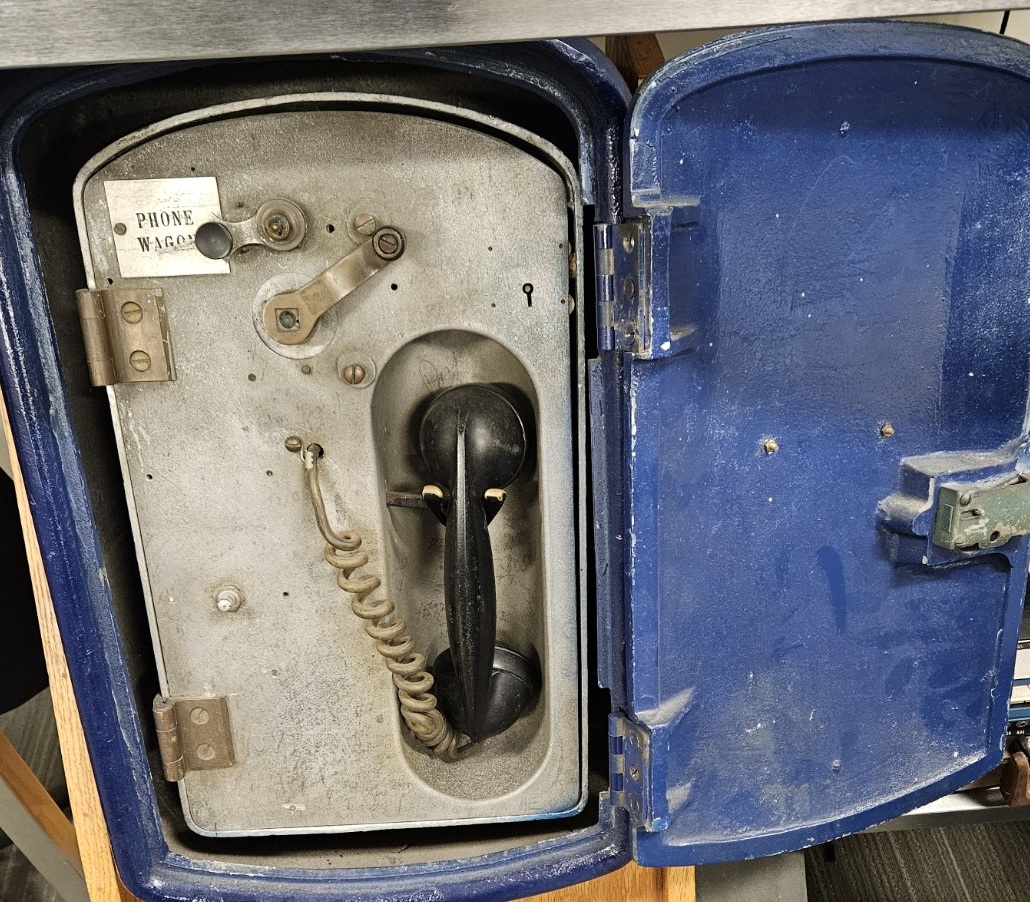
Call boxes, patrolmen, uniforms, street response and the physical geography of police work before the digital age.
VICE · 1949
Permanent Vice assignment, Unit Citation No. 20, raid files and the road toward detective.
THE BUREAUS
Follow the changing units that defined Ralph Palmer's career and the different Detroit each assignment revealed.
TOOLS & METHODS
Equipment, records, surveillance, lineups, polygraphs, court procedure and the methods available in each era.
THE PLACES
Every assignment belonged to a physical Detroit: a precinct house, a bureau, Headquarters, a courtroom, a street corner. Each building connects to photographs, maps, unit history, cases, and the people who worked there when the record supports that connection.
PATROL DETROIT
Patrol establishes the physical language of the department: uniforms, call boxes, nightsticks, handcuffs, revolvers, patrol cars, station houses and the city blocks between them. Individual equipment details will be published only when the historical record supports the exact configuration.

THE BUREAUS
The map changes when the assignment changes. Patrol Detroit is not Vice Detroit. Vice is not Robbery. Robbery is not SIB, Homicide or Narcotics. This timeline serves as a navigation rail into those different working worlds.
THE BADGE CHANGES
Appointments, promotion certificates, personnel records and training documents can sit beside the chronology instead of being isolated in a document gallery. The artifact appears where it matters.
ARCHIVE · CAREER · VERIFIED RECORD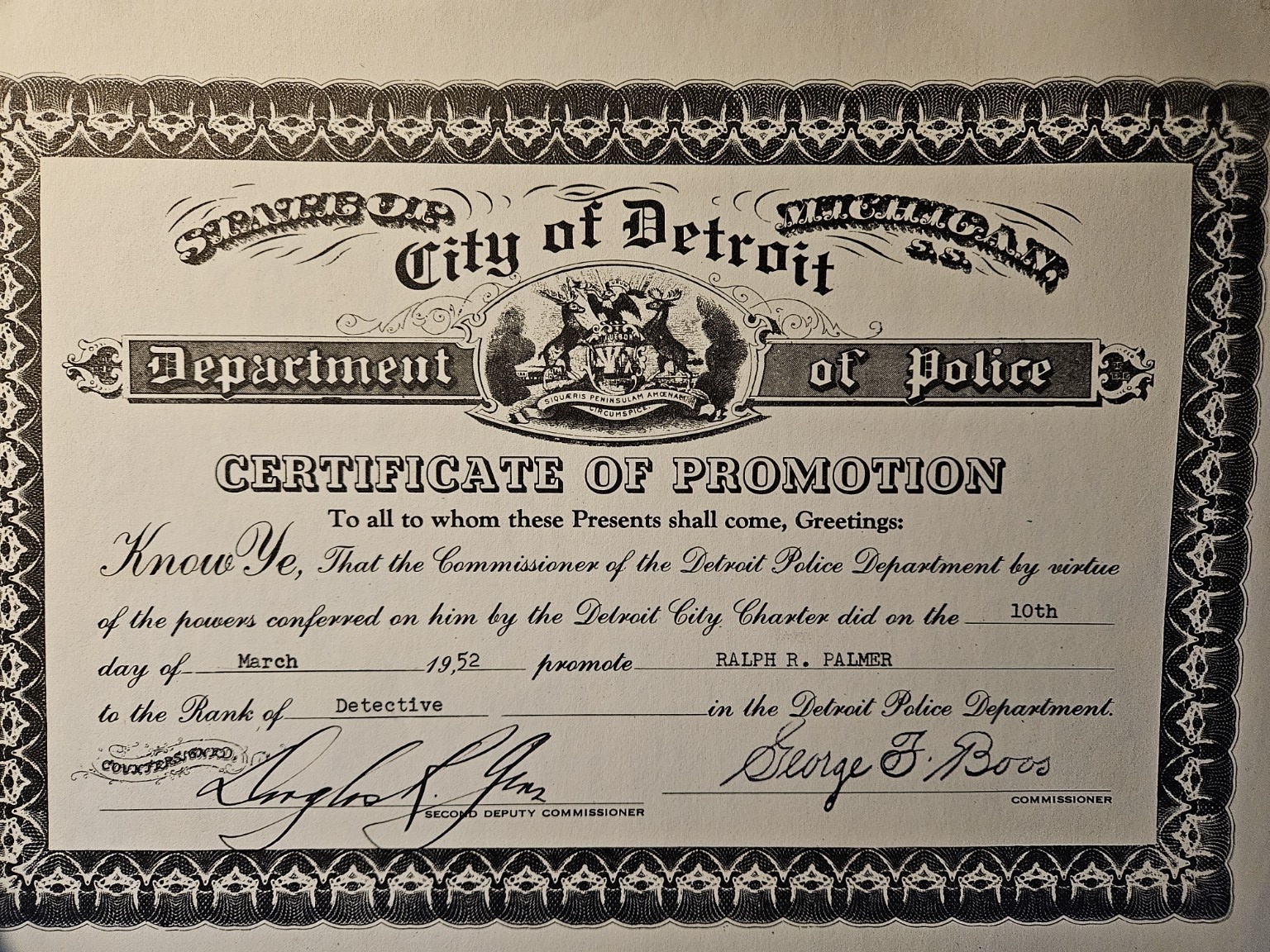
TOOLS & METHODS
This room explains what detectives had—and what they did not. No cell phones. No GPS. No modern DNA profiling. No instant computerized case search. Instead, the story moves through human observation, paper records, telephones, surveillance, witnesses, lineups, fingerprints, polygraphs, court process and the changing technology available in each period.
The physical communications network that connected street officers to the department.
Witness identification, paper files, photographs and other period methods.
Human observation and patient follow-up before digital tracking.
Fingerprinting, physical evidence and laboratory methods appropriate to the specific era.
You should not need to know police jargon to follow Ralph Palmer’s story. These drawers explain the working language of the department and the justice system. Leave them closed if you want the quick tour; open any one when you want the deeper history.
A patrolman was the basic uniformed police rank and the officer most citizens were likely to encounter first. Patrolmen answered calls, walked or drove assigned areas, handled disturbances, made arrests, protected scenes, spoke with witnesses, wrote reports, and brought the department’s authority directly onto the street.
In Ralph Palmer’s early years, patrol work depended on geography and communication in ways that feel very different now. An officer could be away from a station house with no portable digital terminal or cell phone. Knowing the beat, the businesses, the residents, the call boxes, and the routes back to the precinct was part of the job.
Patrol was also the foundation for later investigative work. Reports, observations, arrests, and street judgment made at this level could become the first pages of a detective file.
A detective was an investigator rather than simply a patrol officer in plain clothes. Detectives followed cases after the immediate emergency: interviewing witnesses and suspects, comparing reports, tracing property, arranging identifications, checking records, coordinating with prosecutors, conducting surveillance, and building evidence that could survive court scrutiny.
The work was often less cinematic than the word suggests. Much of it was paperwork, telephones, waiting, re-interviewing, checking addresses, comparing descriptions, and deciding which small inconsistency deserved another day of work.
Ralph Palmer’s promotion to detective changed not only his title but the type of record he left behind. His later career moved through specialized investigative assignments where the case file—not simply the call for service—became the center of the work.
A sergeant is a supervisory rank. Sergeants direct officers, review work, assign tasks, maintain discipline, make decisions at scenes, and translate command decisions into the daily work of a unit. In detective environments, a detective sergeant can supervise investigative personnel and case activity rather than perform the same role as a uniformed patrol sergeant.
The exact duties depend on bureau, shift, era, and department organization. The important distinction is that promotion changes responsibility: the officer is no longer responsible only for his own case or beat but also for the quality and direction of other officers’ work.
Ralph Palmer’s 1963 promotion to Detective Sergeant marks that transition in the project chronology.
A lieutenant is a command rank above sergeant. Lieutenants can oversee sections, shifts, details, or specialized operations, depending on department structure. The work increasingly involves personnel, priorities, coordination, administration, and accountability for the unit as a whole.
Command does not mean investigative experience stops mattering. In specialized bureaus, the credibility of a supervisor often depends on understanding the work being assigned. But the daily focus broadens from solving an individual case to making sure people, information, resources, and policy are moving in the same direction.
Ralph Palmer’s later career reached Detective Lieutenant and command assignments, making rank itself part of the chronology rather than just a title on a badge.
A police call box was a fixed street communication point connected to the department. Officers could use call boxes to report in, receive information, request assistance, or communicate with a station or dispatcher depending on the system and period.
The importance is easy to underestimate today. Before portable radios, mobile data terminals, and cell phones, communication had a physical location. An officer sometimes had to move to the box. That affected response, supervision, beat design, and the way information traveled through the department.
On this site we use the term “police call box” deliberately. It was not simply a decorative street object; it was part of the communications infrastructure of patrol-era Detroit.
Patrol cars expanded how quickly officers could cover distance, respond to calls, transport people, and move between station houses and scenes. A cruiser was not merely transportation; it changed the geography of police work.
Automobiles also changed crime. Robbery crews, burglars, stolen-car offenders, and suspects fleeing a scene could move across precinct boundaries quickly. Police mobility therefore became part of both response and investigation.
Exact vehicle makes, equipment, markings, and radio configurations changed over time. The website treats those details as historical facts to be verified, not generic props.
A precinct is a geographic police district and, by extension, often the command and station serving that area. Station houses were where officers reported, prisoners could be processed, reports were written, supervisors worked, and local police activity was organized.
Precinct boundaries matter historically because Detroit was not policed as one undifferentiated map. The same street could be understood through district boundaries, patrol assignments, nearby stations, and the routes officers used to reach a scene.
For Ralph Palmer, the Sixth Precinct and later Ninth Precinct assignments are not background labels. They locate his early career inside the working map of the department.
Vice units traditionally investigate offenses connected to illegal gambling, illegal liquor, prostitution-related activity, narcotics in some organizational periods, and other prohibited or heavily regulated markets. The exact responsibilities of a bureau change over time, so period records matter.
Vice work often requires a different method from uniformed patrol. An illegal operation may depend on secrecy, controlled access, repeat customers, lookouts, cash, and people who will not voluntarily explain the business to police. Plainclothes observation, informants, surveillance, warrants, undercover methods, and raids can therefore become important.
Ralph Palmer’s permanent 1949 Vice assignment placed him inside this investigative world. The website explains the machinery of vice enforcement while individual case narratives remain protected for the books.
“Hold-up” was common mid-century language for robbery committed through force or threat, often with a weapon. A Hold-Up Bureau or detail focused on robbery patterns, suspects, witnesses, stolen property, weapons, vehicles, lineups, and connections between incidents.
The bureau name can confuse modern readers because “hold up” now sounds informal. In police and newspaper usage of the period it was a practical category of violent property crime. Detectives might compare descriptions and methods across many reports to determine whether one person or crew was responsible for a series.
Ralph Palmer’s 1953 assignment to Hold-Up at Police Headquarters is therefore an important institutional shift: from precinct detective work into a specialized robbery environment.
B&E means “breaking and entering.” Robbery means taking property from a person by force or threat. They are different crimes, but both can demand intensive detective work involving witnesses, stolen property, repeat offenders, vehicles, physical evidence, and patterns across locations.
A bureau combining Robbery and B&E reflects investigative organization, not a claim that the offenses are legally identical. Detectives could work different case types while sharing supervisors, records, suspect information, and methods.
When the project chronology says Ralph moved to Robbery & B&E, the abbreviation is not being used as unexplained insider jargon. It marks a specialized investigative assignment that this drawer helps decode.
SIB is shorthand for Special Investigation Bureau. A special-investigation unit generally handles matters that do not fit neatly into routine precinct or bureau work—often because the subject, sensitivity, scope, or need for discretion requires a specialized team.
The exact responsibilities of Detroit’s SIB must be tied to the period and documentary record; the label should not be used as a catch-all for every unusual investigation. On this site, SIB references are anchored to Ralph Palmer’s documented assignments and to specific verified matters when they are opened for publication.
The main idea for a reader is organizational: SIB represents a shift away from ordinary case intake toward selected investigations handled at a more specialized level.
Homicide detectives investigate deaths that may involve criminal responsibility. The work can include scene examination, witness interviews, suspect development, autopsy and medical information, timelines, weapons, motive evidence, identification, and coordination with prosecutors and forensic personnel.
A homicide case is not automatically a murder case. Investigators first have to establish what happened and whether a criminal offense occurred. That distinction is essential to responsible historical writing as well as police work.
Ralph Palmer’s Homicide assignment belongs to a later portion of his career. This site can explain the bureau without prematurely opening the individual cases reserved for later volumes.
Narcotics enforcement deals with unlawful manufacture, possession, distribution, and trafficking of controlled drugs, but the laws, substances emphasized, terminology, and enforcement structure changed considerably across the twentieth century.
For a historical site, it is important not to project today’s drug-policy language backward without qualification. The relevant statutes, bureau responsibilities, investigative methods, and public concerns must be understood in the period being discussed.
Ralph Palmer’s later narcotics command work therefore represents a distinct era of his career and a different Detroit policing problem from the vice and robbery work of the early 1950s.
A grand jury is a body of citizens empowered to hear evidence and determine whether there is sufficient basis for criminal charges or to investigate matters within its lawful authority. It is not a criminal trial and it does not decide guilt.
Grand-jury proceedings are generally more secret than ordinary courtroom proceedings. Witnesses may be called, records examined, and investigators assigned to develop evidence for the inquiry. The exact procedure depends on jurisdiction and era.
That secrecy is why a “grand-jury investigation” in a historical file can mean something very different from a public courtroom trial. Ralph Palmer’s documented grand-jury work is treated in the project as investigative assignment history, not as proof of guilt by any person merely mentioned in an inquiry.
A felony is a serious category of criminal offense, traditionally distinguished from lesser offenses such as misdemeanors by the potential punishment and legal consequences. What conduct qualifies as a felony is defined by statute and can change over time.
Police officers do not create a felony simply by using the word in a report. Investigators gather facts and evidence; prosecutors determine what charges to authorize or pursue; courts determine legal issues; and guilt must be established through the judicial process.
On a historical website, using “felony” responsibly means tying the term to the law or charging record rather than using it as a dramatic synonym for “serious crime.”
Larceny is a form of theft involving the wrongful taking of another person’s property with intent to deprive the owner of it. Unlike robbery, larceny does not require force or threat against a person. Unlike burglary or breaking and entering, it does not necessarily require unlawful entry into a building.
The distinctions matter because old police records can place similar-looking property losses into different legal categories depending on what actually occurred. A stolen wallet, goods taken from a building, and money surrendered at gunpoint may all involve loss of property, but they are not the same offense.
Understanding the vocabulary keeps the website from flattening every property case into the word “theft.”
The definitions explain the institution. Ralph’s chronology then shows when he actually entered a rank, bureau, or investigative world. The website does not treat a general description as proof of what happened in a specific case.
THE DEPARTMENT CONNECTS TO THE CITY
Later, a precinct can lead to a map. A bureau can lead to its cases. A case can lead to the newspaper room. A promotion can lead back to Ralph's chronology.
THE DEPARTMENT IS OPEN
Precinct histories, patrol cars, badges, uniforms, bureau rosters, training records, equipment, and investigative methods are organized here when supported by verified sources.
← BACK TO EXPLORE DETROITCONTINUE IN THIS CATEGORY