FILE PATHEXPLORE DETROIT/THE STREETS/CRIME CRAWL/THE PURPLE GANG

CRIME CRAWL · ORGANIZED CRIME PATH

THE PURPLE
GANG

Follow three documented turning points through Detroit's Prohibition-era underworld—from labor racketeering to gang warfare and the convictions that helped break the organization.

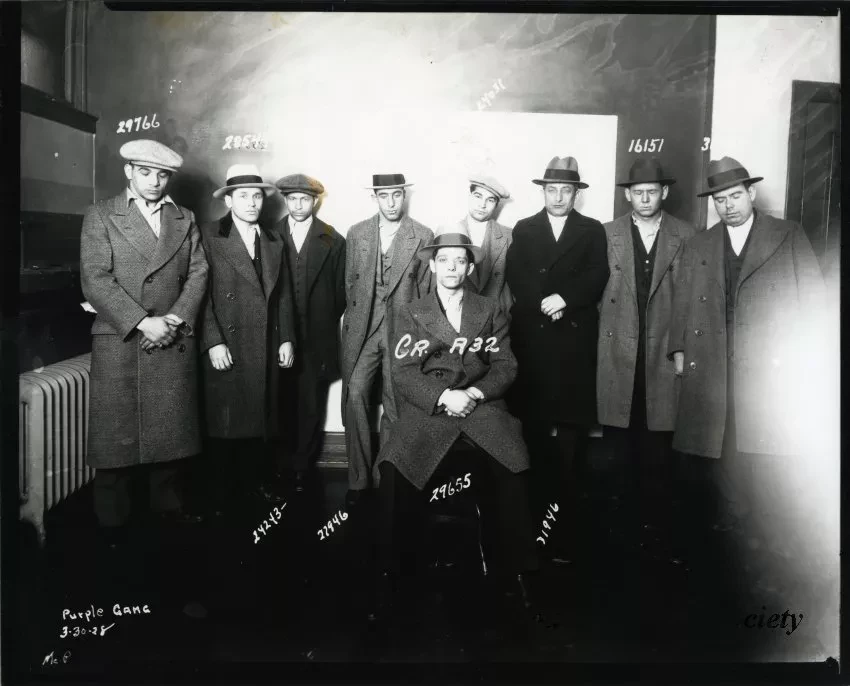
Purple Gang members assembled for a police identification photograph
PURPLE GANG MEMBERS IN POLICE CUSTODY · MARCH 30, 1928 · DETROIT HISTORICAL SOCIETY CATALOG 2016.001.096 · WATERMARKED WEB IMAGE

THE PATH: The Purple Gang did not emerge from one event, and it did not disappear after one prosecution. These three files show an organization using coercion in a legitimate industry, becoming associated with spectacular gang violence, and finally losing leading members to prison. The path supplies Detroit history without entering Ralph Palmer's later investigations.

BEFORE THE HEADLINES

How influence accumulated.

The Purple Gang grew through place, opportunity and criminal partnerships. No single incident created its power; each stage widened the field in which its members could operate.

01 · LOWER EAST SIDE

From neighborhood group to gang

The gang's core developed among young men from Detroit's lower east side. Historical accounts connect some early members to Bishop School and describe the group first as the Sugar House Boys or Sugar House Gang. The Burnstein brothers—Raymond, Joseph, Isadore and Abraham—later became central figures.

02 · PROHIBITION

The river created opportunity

Canada sat across a narrow international border while American Prohibition created enormous demand. Purple Gang members hijacked liquor moving across the Detroit River and became participants in wider smuggling and distribution networks.

FOLLOW PROHIBITION DETROIT →
03 · FEAR & CONNECTIONS

Power beyond bootlegging

The gang remained a loose criminal confederation rather than a public institution with a formal chart. Its influence extended through gambling, protection, labor racketeering and violence. Fear discouraged witnesses, while criminal and business connections broadened its reach.
THREE DOCUMENTED STOPS

Rise, violence and decline.

Nine Purple Gang members photographed in police custody in 1928
ACTUAL PURPLE GANG SUBJECTS · MARCH 30, 1928 · DETROIT HISTORICAL SOCIETY CATALOG 2016.001.096 · WATERMARKED WEB IMAGE
STOP 01 · 1925–1928

Cleaners and Dyers War

A gang-connected association pressured Detroit cleaning businesses to join, pay and follow its price structure. Historical accounts describe intimidation, property damage, assault and bombing during the campaign. Thirteen defendants were tried for extortion in 1928 and acquitted.

OPEN THE FULL FILE →
Purple Gang members in a police identification photograph
PURPLE GANG MEMBERS IN POLICE CUSTODY · 1928 · CONTEXT IMAGE · DOES NOT SHOW THE MILAFLORES SCENE
STOP 02 · MARCH 1927

Milaflores Massacre

Three men were killed in a Detroit apartment building in a case associated with Purple Gang warfare. The event became known for the use of a machine gun. This path does not publish an exact apartment pin until a stronger location record is secured.

OPEN THE FULL FILE →
Purple Gang figures photographed in 1928, used as context for the Collingwood Manor file
PURPLE GANG CONTEXT · 1928 · NOT APARTMENT 211 OR THE 1931 MURDER SCENE
STOP 03 · SEPTEMBER 16, 1931

Collingwood Manor

Joe Lebowitz, Hymie Paul and Isadore Sutker were killed at Apartment 211, 1740 Collingwood Avenue. Sol Levine later testified. Ray Burnstein, Harry Keywell and Irving Milberg received life sentences, and the case became a turning point in the Purple Gang's decline.

OPEN THE FULL CRIME FILE →

WHEN POWER FRACTURED

The organization came apart from within and without.

The Purple Gang's decline was not one clean ending. Internal violence, testimony, convictions, deaths and competing organizations steadily reduced its collective control.

07 · WITNESS & CONVICTIONS

Collingwood broke the silence

Sol Levine's testimony helped produce life sentences for Ray Burnstein, Harry Keywell and Irving Milberg. Removing central figures weakened an organization that had long benefited from frightened or unavailable witnesses.

OPEN COLLINGWOOD MANOR →
08 · FRAGMENTATION

No single final day

By approximately 1935, historical accounts describe the alliance as splintered. Members had been killed, imprisoned or divided by rivalry. Other organizations occupied parts of the underworld the Purples no longer controlled, although individual former members continued criminal activity afterward.

WHAT THIS JOURNEY DOES NOT CLAIM: It does not treat every Detroit Prohibition crime as Purple Gang activity, claim that every member followed one chain of command, or repeat movie-created cement-shoes folklore as history.

PHOTO & SOURCE NOTE

These photographs establish atmosphere and identifiable Purple Gang context; neither is presented as a photograph of the Cleaners and Dyers attacks, the Milaflores killings or the Collingwood Manor crime scene. Historical wording is assembled from multiple records and remains inside this website. READ OUR SOURCE NOTES →

CONTINUE IN THIS CATEGORY